UPI's free ride actually costs
The slow return of MDR: what UPI's free ride actually costs
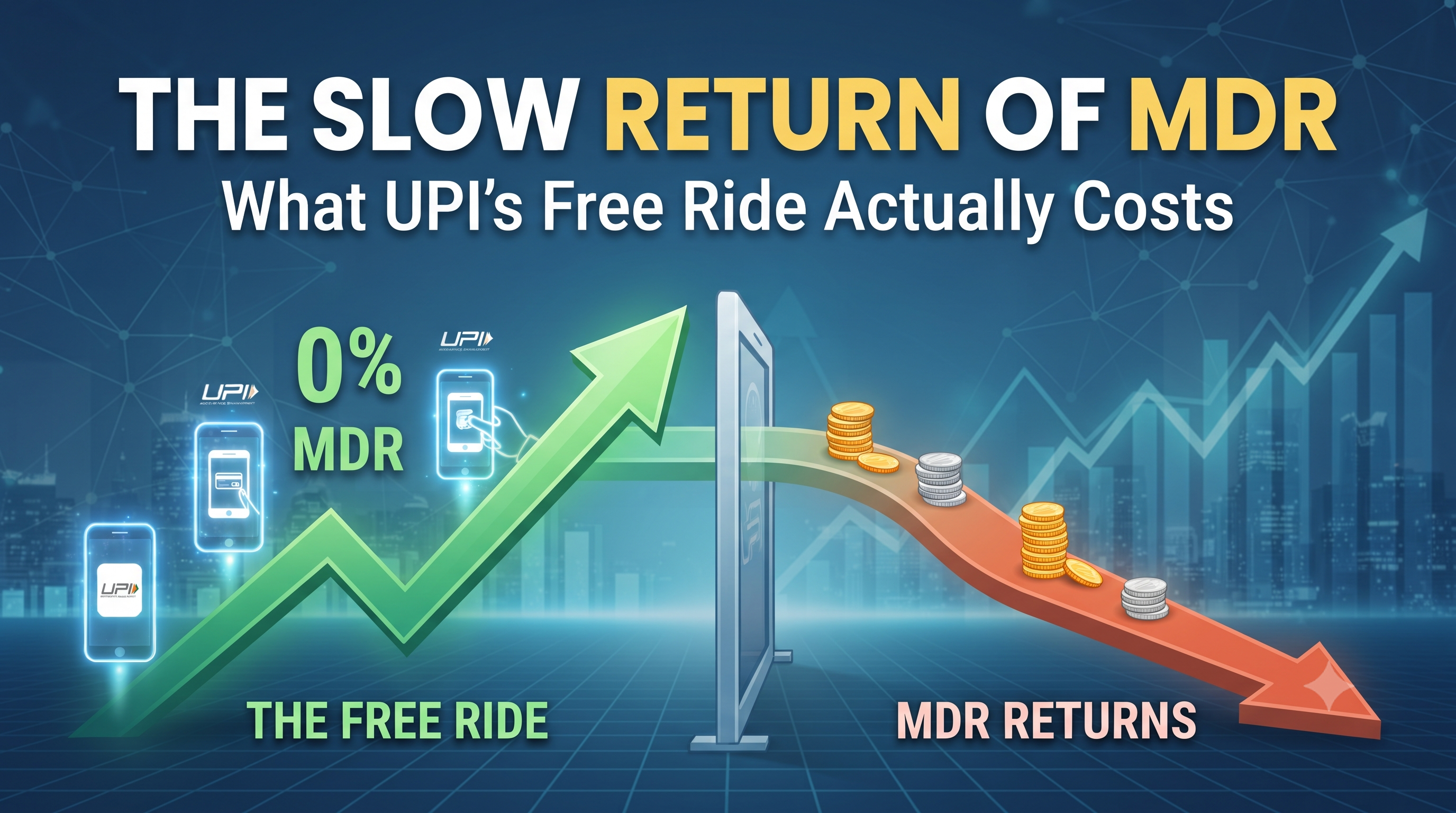
The Slow Return of MDR: What UPI's Free Ride Actually Costs the Economy
India just amended the law that made UPI free. While no charges are active yet, the government now holds the power to reintroduce the Merchant Discount Rate (MDR). Here is the financial arithmetic behind the debate.
Since January 2020, the Unified Payments Interface (UPI) has operated on a simple promise: zero Merchant Discount Rate (MDR) for all users. This strategy transformed a payment rail into essential national infrastructure. However, it also meant that banks and fintech companies received zero compensation for processing trillions in volume. In late 2026, Parliament reopened the question of sustainability.
Evolution of UPI Fees: How India Got to Zero MDR
When UPI launched in 2016, it carried a standard MDR of up to 0.30% on P2M (Person-to-Merchant) transactions. By 2020, the Indian government zeroed out these fees for UPI and RuPay debit cards, subsidizing digital payments as a public good. This spurred explosive adoption, making UPI the world's largest real-time payment system.
The Cost of "Free": Who Pays for UPI Infrastructure?
Zero MDR does not mean zero cost. The financial burden shifted from the merchant's invoice to the government's subsidy budget and the balance sheets of Payment Service Providers (PSPs) and banks.
Projected UPI MDR Rates and Merchant Impacts
While final rates are not yet fixed, industry discussions suggest a narrow range compared to traditional credit card fees.
Targeting High-Value Transactions
The data suggests that any new UPI merchant charges will target only a small sliver of high-value volume, ensuring that small vendors and person-to-person (P2P) transfers remain free of cost.
Legal Status: Payment and Settlement Systems Act Amendment
Understanding the legal mechanics of the 2026 policy shift is crucial for merchants and fintech firms.
Stakeholder Analysis: The Case for and Against UPI MDR
Arguments for Sustaining Zero MDR
- Ensures mass adoption by small kirana stores and street vendors.
- Prevents costs from being passed down to the end consumer.
- Positions UPI as a digital public good, accelerating financial inclusion.
The Case for Reintroducing MDR
- Addresses the multi-thousand crore funding gap for banks and PSPs.
- Discourages unregulated "tech fees" currently levied by banks on large merchants.
- Creates a sustainable revenue model for fintech innovation.
What Payment Aggregators and Fintechs Are Saying
Summary of Payment Status (September 2026)
| Transaction Category | Fee Status |
|---|---|
| UPI Person-to-Person (P2P) | Always Free |
| UPI Merchant Payments < ₹2,000 | Free |
| RuPay Debit Cards | Free |
| UPI Merchant Payments > ₹2,000 | Notification Pending |
| Consumer-Facing Fees | No Proposal |